2 February 2017: Because he is one of my heroes, because I am teaching his _Narrative_ tomorrow in ENGL 204, and because he's in the news (thanks to a certain president who obviously didn't pay attention in class), I was delighted to come across this poem about Frederick Douglass, written by the fantastic Robert Hayden.
When it is finally ours, this freedom, this liberty, this beautiful
and terrible thing, needful to man as air,
usable as earth; when it belongs at last to all,
when it is truly instinct, brain matter, diastole, systole,
reflex action; when it is finally won; when it is more
than the gaudy mumbo jumbo of politicians:
this man, this Douglass, this former slave, this Negro
beaten to his knees, exiled, visioning a world
where none is lonely, none hunted, alien,
this man, superb in love and logic, this man
shall be remembered. Oh, not with statues’ rhetoric,
not with legends and poems and wreaths of bronze alone,
but with the lives grown out of his life, the lives
fleshing his dream of the beautiful, needful thing.
Showing posts with label Frederick Douglass. Show all posts
Showing posts with label Frederick Douglass. Show all posts
Thursday, February 2, 2017

Friday, May 28, 2010
Random links...
These are really just a collection of things I've been meaning to post--they are completely unrelated to each other...
1) The Drunk History series from Funny or Die. The thing is, take out some of the drunken excesses, and she sounds a bit like me teaching Frederick Douglass to my class. Or the pretentious drunken (and hilarious) conversations at any party in graduate school.
2) Louis Black on Glenn Beck's Nazi Tourette's. Awesome.
3) A 1927 map by Paramount Studios of fake filming locations (places in California that sort of look like other places.)
4) Love love love this vending machine.
5) A rare video clip of one my personal heroes, Victor Frankl, talking about man's search for meaning. (Read the book!)
6) From Saudi Arabia, the most terrifying commercial ever. Seriously, it's nightmare material...
7) To wipe that previous clip from your mind, check out this one, of a baby hearing sound for the very first time.
1) The Drunk History series from Funny or Die. The thing is, take out some of the drunken excesses, and she sounds a bit like me teaching Frederick Douglass to my class. Or the pretentious drunken (and hilarious) conversations at any party in graduate school.
2) Louis Black on Glenn Beck's Nazi Tourette's. Awesome.
3) A 1927 map by Paramount Studios of fake filming locations (places in California that sort of look like other places.)
4) Love love love this vending machine.
5) A rare video clip of one my personal heroes, Victor Frankl, talking about man's search for meaning. (Read the book!)
6) From Saudi Arabia, the most terrifying commercial ever. Seriously, it's nightmare material...
7) To wipe that previous clip from your mind, check out this one, of a baby hearing sound for the very first time.
Wednesday, June 4, 2008
About last night...
No matter your party affiliation, you can't deny that a bit of history was made last night (despite Senator Clinton's destructive delusions that this thing isn't over yet). Over at Andrew Sullivan's Daily Dish, readers have been sending in their responses. Here are two that I found particularly moving:
1) "Tomorrow I will go to the African American cemetery outside of Chicago where my great-grandparents, grandparents, aunts, uncles, friends, neighbors, and my mother and father are buried. And I will tell them that they were right -- that if we studied hard, worked hard, kept the faith, fought for justice, prayed, that this day would come.
Grandpa drove a truck for over 50 years, and he told the story of how he drove with a team of drivers, 2 white (including him), and 4 black. When they stopped at the truck stops, the black drivers had to use separate restrooms and showers, and had to eat in a small room in the back of the kitchen. Grandpa and his co-driver would eat in the back with the rest of the team, and while they didn't speak of it at the time, they knew it was wrong yet felt powerless to change it, and believed that it would never change.
"The Americans of all nations at any time upon the earth have probably the fullest poetical nature. The United States themselves are essentially the greatest poem. In the history of the earth hitherto the largest and most stirring appear tame and orderly to their ampler largeness and stir. Here at last is something in the doings of man that corresponds with the broadcast doings of the day and night. Here is not merely a nation but a teeming nation of nations. Here is action untied from strings necessarily blind to particulars and details magnificently moving in vast masses. Here is the hospitality which forever indicates heroes . . ."
Again, Republican, Democrat, whatever you are--you have reason to smile today and be extra proud to be an American.
1) "Tomorrow I will go to the African American cemetery outside of Chicago where my great-grandparents, grandparents, aunts, uncles, friends, neighbors, and my mother and father are buried. And I will tell them that they were right -- that if we studied hard, worked hard, kept the faith, fought for justice, prayed, that this day would come.
And it has."
2) "My grandfather, 86 years old and a veteran of WWII, just gave me a call. He was calling all of his grandchildren to let them know what an important night this was in the history of our country.Grandpa drove a truck for over 50 years, and he told the story of how he drove with a team of drivers, 2 white (including him), and 4 black. When they stopped at the truck stops, the black drivers had to use separate restrooms and showers, and had to eat in a small room in the back of the kitchen. Grandpa and his co-driver would eat in the back with the rest of the team, and while they didn't speak of it at the time, they knew it was wrong yet felt powerless to change it, and believed that it would never change.
Tonight, he told me, we have come full-circle. Many people, especially the younger generation who supported Obama, will never fully realize the historical import of what happened tonight. But he wanted his grandchildren to know this story that he had never told us, and it was the second time in my 33 years that I have heard my grandpa cry."
Yesterday, I taught The Narrative of the Life of Frederick Douglass and selections from Stowe's Uncle Tom's Cabin in English 204. What would they--especially Douglass--have to say about how far we've come in American politics? Today in class, we discussed that great American poet, Walt Whitman. How perfect, right? Consider what Whitman writes in the Preface to Leaves of Grass:"The Americans of all nations at any time upon the earth have probably the fullest poetical nature. The United States themselves are essentially the greatest poem. In the history of the earth hitherto the largest and most stirring appear tame and orderly to their ampler largeness and stir. Here at last is something in the doings of man that corresponds with the broadcast doings of the day and night. Here is not merely a nation but a teeming nation of nations. Here is action untied from strings necessarily blind to particulars and details magnificently moving in vast masses. Here is the hospitality which forever indicates heroes . . ."
Again, Republican, Democrat, whatever you are--you have reason to smile today and be extra proud to be an American.
Wednesday, February 27, 2008
Frederick Douglass National Historic Site
Back in January, when I was compiling my mental list of "things that will cause me stress this semester," one item loomed at the top of the chart: Field trips with my English 204 Honors class. The Honors Program here is Shepherd is great and I am having a blast teaching my section this semester. Every class with this group of students is such a treat. But one expectation of teaching these courses is that you will take the students outside the classroom. That makes sense to me and it's a pretty cool feature of the program. However, thinking about actually doing it brought me nothing but anxiety.
Since our class is so small (eleven students) and bus rentals are so expensive, I'd be driving us (in a university vehicle) for any trip we took. Now if you know me, you know I don't do travel well in an ordinary circumstance. I like being in new places and seeing new things, but the stress associated with getting there gets to me. I know why: I have the worst luck when it comes to traffic, airport delays, etc. Trips that take normal people two hours are likely to take me four, or eight, or twelve. Plus, my mother, who does not respond well at all to traffic or being lost or any of that stuff, instilled an deep sense of unease about traveling in me. It has taken me years to realize that missing a turn isn't a big deal--just relax and turn around. But it never seemed that simple when I was young and missed turns equaled meltdowns of mythic proportions. (Lord, I hope she never reads this post.) Anyway, don't get me wrong--I love a loose, relaxed road trip where we aren't racing to get somewhere (for, let's say, a job interview). But the idea of me taking eleven undergrads--in a van--into Washington D.C. (the only real feasible location for these kinds of trips) worried me--a lot.
I will spare you the details of the saga of working out transportation for our first scheduled trip, but needless to say, it was an almost epic process. In the end, on the cold and icy morning of February 14, 2008, I set out in a university mini-van. My companions? Eleven brave students and one RA who volunteered to drive a second vehicle (don't even ask--I told you there were details I am leaving out). Our destination? The Frederick Douglass National Historic Site. We had read Douglass's Narrative in class and since I think Douglass is one of the most important voices to listen to in an American literature survey course, a visit to his house made sense.
As it turns out (and I didn't know this when I picked the date), February 14 is the day Douglass picked to celebrate his birthday and the site was holding a 190th birthday celebration for him that morning. We were all excited about our good luck in choosing that date and were eager to get to the site for the ceremony, which began at 10:00 a.m. We pulled out of the Shepherd parking lot at 7:50.
FOUR HOURS LATER, we arrived at the museum. The trip that was supposed to take 1 hour and 40 minutes took oh-so-much longer. The last eight miles or so took us two hours. That's DC traffic for you. (This really wasn't my fault. I checked with folks later who said that we had actually left Shepherd at the "right time" to get to DC. Apparently, if we had left earlier, it would have been even worse as there would have been even more rush hour traffic.)
Of course, we were all very disappointed that we missed the birthday ceremony, but I could not have asked for a better group of students to be on this adventure with that day. No one really complained about the length of the trip. Then later, when we were waiting outside the house for tours (in way below freezing temperatures), they were great sports, too. In fact, they were trying to make me feel better about it. (Maybe they were concerned about me after the bit of cursing and steering-wheel-pounding I was doing under my breath while we were stuck in traffic?)
Maybe they were just trying to make me happy, but in the end, the students said they enjoyed the trip and actually learned a thing or two. I suppose the whole incident wasn't too bad. Even driving the mini-van in DC traffic (through a couple of not-so-nice neighborhoods)--with another van with half of my class following me--even that wasn't bad. If it weren't for that traffic, the whole thing would have been perfect.
Anyway, how about some pictures from the visit?

Here's the outside of the house. You can see some of my students on the left. The house is small enough that they were only letting fifteen people tour at a time, which meant lots of standing out in the cold, since there were about fifty people in front of us. Douglass and his family moved to the house in 1877. Although the neighborhood where the house is is currently rather depressed (not a place you'd want to be at night), at the time, the location must have seemed amazing, as it is set up on a hill overlooking the Anacostia River and the city.

Andrew, Rachel, and Kara--see how they are smiling even though they are freezing? Good kids.

More cold students: Lawren, Emily (my navigator on the trip!), Austin, and Sara.

Even more shivering students: Rob (the driver of the other mini-van), Liz, Jessica, and Anthony.
Finally, finally, finally, we got in the house, although our group was broken up in two. Originally, we were all in agreement and singing songs of unity: "We'll go in together as one group!" After about twenty minutes in the freezing cold, that "let's stick together" mentality broke down. When the tour guide said, "We can take seven more in this group," seven of my students jumped at the chance to get inside. Screw the rest of us, who waited a bit more, but finally got inside.

Douglass's front parlor. I took one picture of this room, but it's worth including because of the picture of Lincoln above the fireplace.

From the study: Douglass's desk. Call me a nerd, but I love seeing famous peoples' desks.

Also from the study, just some of Douglass's books. I wish I could have gotten closer to make out some of the titles, but they had those velvet ropes. It's like Studio 54 for geeks.
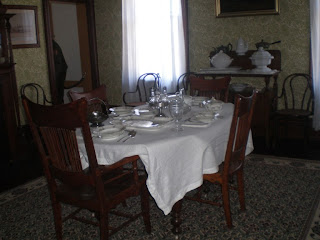
The dining room: This was an impressive room, especially when you realized the famous people Douglass would have hosted in here.

Dining room: a silver tea service. I am including this photo because is a pretty good symbol for Douglass's wealth. One of the themes that the tour guides (and there were about five of them stationed through the house) kept emphasizing during our visit was how wealthy Douglass had become at the point that he could afford this house. Later, in class, the students talked about how they were surprised by that emphasis. I think they were expecting more of an emphasis on "Douglass the Slave" and not "Douglass the Millionaire." (And he was indeed a millionaire by the time he died.) I explained to them, though, that the tour guides must have been struck by the power of that transformation--the little boy born into slavery on a plantation ends up the powerful diplomat and leader. It really is a wonderful American success story. Douglass's life shows how hard work and determination can lead to great rewards--a great lesson for us all, especially the groups of inner-city elementary and middle-schoolers who took the tour ahead of us. So perhaps we can forgive the guides for occasionally lapsing into a 19th-century version of MTV's Cribs.

Dining room: I am including this picture for two reasons. First, the objects on the mantel are some of the things Douglass brought back from his trips all over the world, including Europe, Africa and Asia. They illustrate just how cultured and well-traveled he was. Second, the picture above the mantel (I know it isn't all that clear) shows Douglass and members of Grant's cabinet. Again, it just demonstrates how powerful he was.

The pantry: an ice-box, another symbol of Douglass's wealth, and evolving 19th-century technology.

Pantry: I really love this picture. It's an ice-cream maker, yet another sign that the Douglass family had means...and dessert!

Kitchen: the stove, apparently a "top-of-the-line" appliance back in the day.

One of the guest rooms. I really liked this look of this room--right down to the wallpaper. I believe the tour guide said Paul Laurence Dunbar had stayed here, which is also pretty darn cool.

One of Douglass's wives' rooms: I am not sure which wife (his first or his second) used this room--the tour guide didn't specify and we didn't ask too many questions since by this point, half our group was back out in the cold, but she did say that after Wife #1 died, Wife #2 (who came along pretty quickly) took a different room as her own. I found this quite interesting given that there was some controversy about that second marriage. (And yes, it would have been very common back then for husbands and wives to have separate rooms. In fact, it was even a sign of material wealth.)

Douglass's bedroom, complete with some of his personal items (like that hat on the chair).

Douglass's bedroom: a close up of his chair, his shoes, and his weights. Douglass was an active and physically fit man for most of his life, so the weights make sense.
After the house tour, we picked up the rest of our group, took a few more pictures, and headed back to the visitor's center before hitting the road. Just a few more pictures:

The whole group posed outside the house.

A close-up of the group, although I took it before everyone was ready. I actually think that makes it a better picture.

A statue of Douglass in the Visitor's Center.
As I said, all in all, it was a good trip. I say that as a teacher, even as I try to tell myself that the students' favorite part wasn't when we stopped for lunch at Pizza Hut. If, in the end, our trip made us have a better appreciation for Douglass and his achievements and we carry that appreciation back to the study of his writings and the writing of his contemporaries, and if we can use what we learned to inform our discussions of American literature, then the trip was a success, traffic or no traffic.
Lest you think this is too rosy a conclusion, I'll end with this: with all that said, am I eager to hop back into the minivan and take them on another trip? Not so much...but I'm working on it.
Since our class is so small (eleven students) and bus rentals are so expensive, I'd be driving us (in a university vehicle) for any trip we took. Now if you know me, you know I don't do travel well in an ordinary circumstance. I like being in new places and seeing new things, but the stress associated with getting there gets to me. I know why: I have the worst luck when it comes to traffic, airport delays, etc. Trips that take normal people two hours are likely to take me four, or eight, or twelve. Plus, my mother, who does not respond well at all to traffic or being lost or any of that stuff, instilled an deep sense of unease about traveling in me. It has taken me years to realize that missing a turn isn't a big deal--just relax and turn around. But it never seemed that simple when I was young and missed turns equaled meltdowns of mythic proportions. (Lord, I hope she never reads this post.) Anyway, don't get me wrong--I love a loose, relaxed road trip where we aren't racing to get somewhere (for, let's say, a job interview). But the idea of me taking eleven undergrads--in a van--into Washington D.C. (the only real feasible location for these kinds of trips) worried me--a lot.
I will spare you the details of the saga of working out transportation for our first scheduled trip, but needless to say, it was an almost epic process. In the end, on the cold and icy morning of February 14, 2008, I set out in a university mini-van. My companions? Eleven brave students and one RA who volunteered to drive a second vehicle (don't even ask--I told you there were details I am leaving out). Our destination? The Frederick Douglass National Historic Site. We had read Douglass's Narrative in class and since I think Douglass is one of the most important voices to listen to in an American literature survey course, a visit to his house made sense.
As it turns out (and I didn't know this when I picked the date), February 14 is the day Douglass picked to celebrate his birthday and the site was holding a 190th birthday celebration for him that morning. We were all excited about our good luck in choosing that date and were eager to get to the site for the ceremony, which began at 10:00 a.m. We pulled out of the Shepherd parking lot at 7:50.
FOUR HOURS LATER, we arrived at the museum. The trip that was supposed to take 1 hour and 40 minutes took oh-so-much longer. The last eight miles or so took us two hours. That's DC traffic for you. (This really wasn't my fault. I checked with folks later who said that we had actually left Shepherd at the "right time" to get to DC. Apparently, if we had left earlier, it would have been even worse as there would have been even more rush hour traffic.)
Of course, we were all very disappointed that we missed the birthday ceremony, but I could not have asked for a better group of students to be on this adventure with that day. No one really complained about the length of the trip. Then later, when we were waiting outside the house for tours (in way below freezing temperatures), they were great sports, too. In fact, they were trying to make me feel better about it. (Maybe they were concerned about me after the bit of cursing and steering-wheel-pounding I was doing under my breath while we were stuck in traffic?)
Maybe they were just trying to make me happy, but in the end, the students said they enjoyed the trip and actually learned a thing or two. I suppose the whole incident wasn't too bad. Even driving the mini-van in DC traffic (through a couple of not-so-nice neighborhoods)--with another van with half of my class following me--even that wasn't bad. If it weren't for that traffic, the whole thing would have been perfect.
Anyway, how about some pictures from the visit?

Here's the outside of the house. You can see some of my students on the left. The house is small enough that they were only letting fifteen people tour at a time, which meant lots of standing out in the cold, since there were about fifty people in front of us. Douglass and his family moved to the house in 1877. Although the neighborhood where the house is is currently rather depressed (not a place you'd want to be at night), at the time, the location must have seemed amazing, as it is set up on a hill overlooking the Anacostia River and the city.

Andrew, Rachel, and Kara--see how they are smiling even though they are freezing? Good kids.

More cold students: Lawren, Emily (my navigator on the trip!), Austin, and Sara.

Even more shivering students: Rob (the driver of the other mini-van), Liz, Jessica, and Anthony.
Finally, finally, finally, we got in the house, although our group was broken up in two. Originally, we were all in agreement and singing songs of unity: "We'll go in together as one group!" After about twenty minutes in the freezing cold, that "let's stick together" mentality broke down. When the tour guide said, "We can take seven more in this group," seven of my students jumped at the chance to get inside. Screw the rest of us, who waited a bit more, but finally got inside.

Douglass's front parlor. I took one picture of this room, but it's worth including because of the picture of Lincoln above the fireplace.

From the study: Douglass's desk. Call me a nerd, but I love seeing famous peoples' desks.

Also from the study, just some of Douglass's books. I wish I could have gotten closer to make out some of the titles, but they had those velvet ropes. It's like Studio 54 for geeks.

The dining room: This was an impressive room, especially when you realized the famous people Douglass would have hosted in here.

Dining room: a silver tea service. I am including this photo because is a pretty good symbol for Douglass's wealth. One of the themes that the tour guides (and there were about five of them stationed through the house) kept emphasizing during our visit was how wealthy Douglass had become at the point that he could afford this house. Later, in class, the students talked about how they were surprised by that emphasis. I think they were expecting more of an emphasis on "Douglass the Slave" and not "Douglass the Millionaire." (And he was indeed a millionaire by the time he died.) I explained to them, though, that the tour guides must have been struck by the power of that transformation--the little boy born into slavery on a plantation ends up the powerful diplomat and leader. It really is a wonderful American success story. Douglass's life shows how hard work and determination can lead to great rewards--a great lesson for us all, especially the groups of inner-city elementary and middle-schoolers who took the tour ahead of us. So perhaps we can forgive the guides for occasionally lapsing into a 19th-century version of MTV's Cribs.

Dining room: I am including this picture for two reasons. First, the objects on the mantel are some of the things Douglass brought back from his trips all over the world, including Europe, Africa and Asia. They illustrate just how cultured and well-traveled he was. Second, the picture above the mantel (I know it isn't all that clear) shows Douglass and members of Grant's cabinet. Again, it just demonstrates how powerful he was.

The pantry: an ice-box, another symbol of Douglass's wealth, and evolving 19th-century technology.

Pantry: I really love this picture. It's an ice-cream maker, yet another sign that the Douglass family had means...and dessert!

Kitchen: the stove, apparently a "top-of-the-line" appliance back in the day.

One of the guest rooms. I really liked this look of this room--right down to the wallpaper. I believe the tour guide said Paul Laurence Dunbar had stayed here, which is also pretty darn cool.

One of Douglass's wives' rooms: I am not sure which wife (his first or his second) used this room--the tour guide didn't specify and we didn't ask too many questions since by this point, half our group was back out in the cold, but she did say that after Wife #1 died, Wife #2 (who came along pretty quickly) took a different room as her own. I found this quite interesting given that there was some controversy about that second marriage. (And yes, it would have been very common back then for husbands and wives to have separate rooms. In fact, it was even a sign of material wealth.)

Douglass's bedroom, complete with some of his personal items (like that hat on the chair).

Douglass's bedroom: a close up of his chair, his shoes, and his weights. Douglass was an active and physically fit man for most of his life, so the weights make sense.
After the house tour, we picked up the rest of our group, took a few more pictures, and headed back to the visitor's center before hitting the road. Just a few more pictures:

The whole group posed outside the house.

A close-up of the group, although I took it before everyone was ready. I actually think that makes it a better picture.

A statue of Douglass in the Visitor's Center.
As I said, all in all, it was a good trip. I say that as a teacher, even as I try to tell myself that the students' favorite part wasn't when we stopped for lunch at Pizza Hut. If, in the end, our trip made us have a better appreciation for Douglass and his achievements and we carry that appreciation back to the study of his writings and the writing of his contemporaries, and if we can use what we learned to inform our discussions of American literature, then the trip was a success, traffic or no traffic.
Lest you think this is too rosy a conclusion, I'll end with this: with all that said, am I eager to hop back into the minivan and take them on another trip? Not so much...but I'm working on it.
Subscribe to:
Posts (Atom)